May 23, 2026 · 5 min read
How to tell if jewelry online is actually worth buying
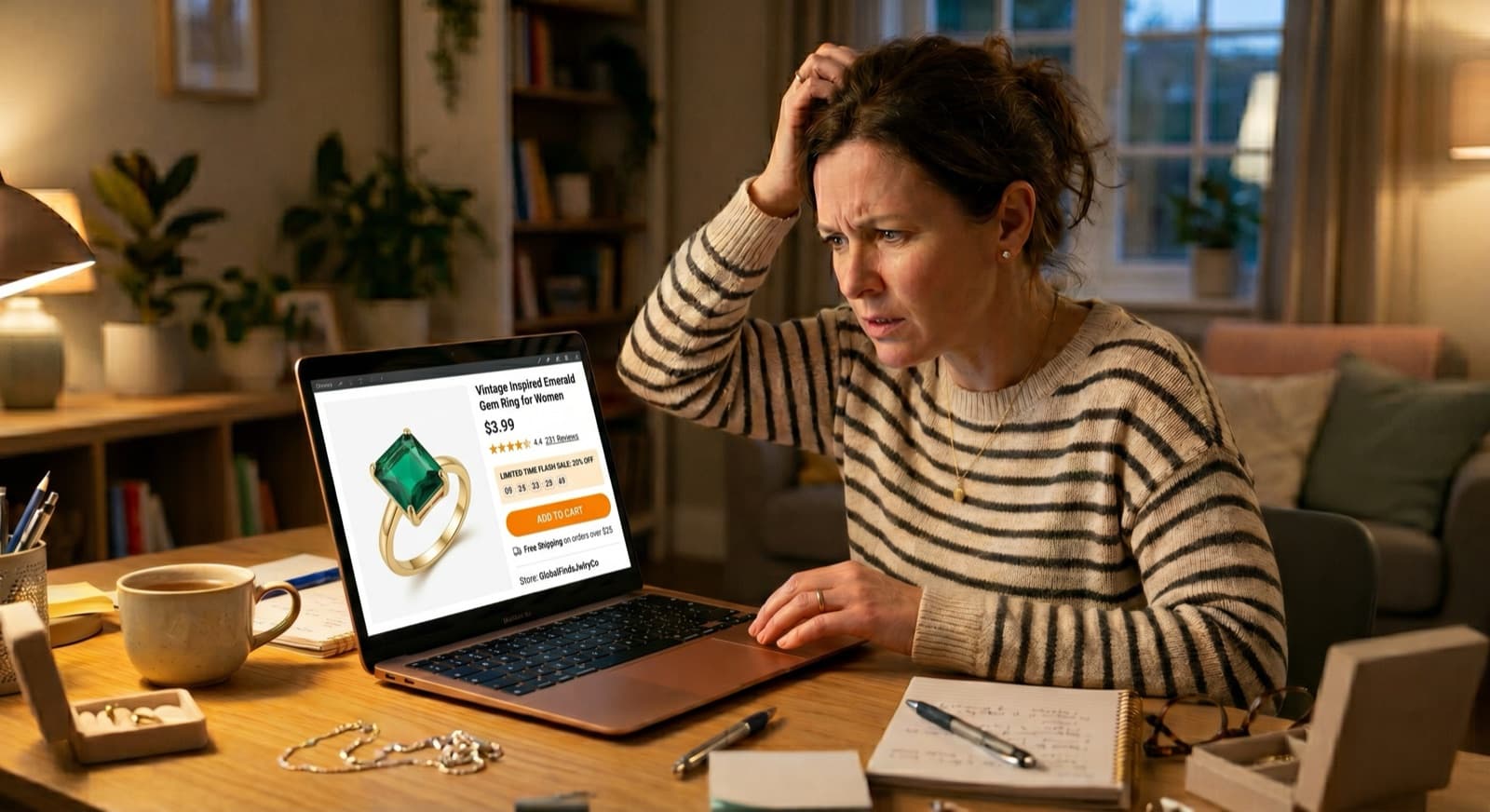
You’ve seen the listings. “14k gold chain, $9, free shipping.” Stock photo, no detail shots, vague description, and somehow 4.7 stars from 12,000 reviews. You know it’s not real gold. You know it’s going to turn your neck green by Thursday. And yet the listings keep coming, drowning out the actual nice pieces you’d happily pay for.
This is the state of jewelry shopping online in 2026, and it’s exhausting. The good stuff exists. It’s just buried under an avalanche of dropshipped imitations and the platforms haven’t built the tools to help you sort through it.
So here’s a field guide. Five things to check before you click buy.
1. The metal type is stated, and it’s specific
Real listings name the metal. “14k gold-filled.” “Sterling silver.” “Solid 925.” “Stainless steel” (which is actually great for everyday wear, by the way).
Vague listings hide behind words like “gold-tone,” “fashion metal,” “alloy,” or the dreaded “gold-plated” with no base metal disclosed. These are not the same thing. Gold-plated brass will tarnish in a few months. Gold-filled has a substantial layer of actual gold bonded to the base and lasts years. If a listing won’t tell you the difference, it’s because the answer isn’t flattering.
Bonus red flag: the listing says “18k gold” and the price is $12. It isn’t.
Not sure how to check what’s actually in your hand? Here’s how to tell if jewelry is really sterling silver and the real difference between gold-filled, gold-plated, and solid gold.
2. The stone is named, not vibed
“Crystal” is not a gemstone. “Gemstone” is not a gemstone. “Diamond-like” is definitely not a diamond.
A real listing tells you what the stone is (cubic zirconia, moissanite, lab-grown sapphire, freshwater pearl, whatever) and treats it as a feature, not a mystery. Cubic zirconia is a legitimate, beautiful stone at the right price point. The problem isn’t CZ. The problem is when sellers won’t say the word.
Pearls are their own category of tricky, since a fake strand can look convincing in a photo. Here’s how to tell if pearls are real before you buy, including the tooth test.
3. The photos show the actual piece
You want to see:
- The clasp (is it a real lobster clasp or a flimsy spring ring that’ll snap in a week?)
- The back of the piece (finished or rough?)
- Any hallmarks or stamps (925, 14k, the maker’s mark)
- The piece worn on a real person, not just floating on a white background
- Weight or measurements, ideally next to something for scale
If every photo looks like it came from the same product database that every other listing is using, that’s because it did.
4. The price makes sense
There’s a floor. Real sterling silver costs money to produce. Real gold-fill costs more. A listing that’s selling “solid 14k gold hoops” for $15 is doing one of two things: lying about the metal, or selling something they’re going to disappear with before you notice.
Use a sanity check. If a comparable piece from a known brand retails for $80, a $9 dupe is not the same product with a better price. It’s a different product wearing the same outfit.
5. The seller is a real person with a track record
This is the part most platforms make hard. Who is selling this? Have they sold anything before? Do other buyers say the piece matched the listing?
A seller with actual reviews, a profile, and a history of listings is a different animal from a faceless storefront with 40,000 SKUs and no return policy. The first one has skin in the game. The second one has a warehouse.
Quick answers to questions buyers ask
What does “gold-filled” actually mean? Gold-filled means there’s a real, legally required layer of actual gold (at least 5% of the item’s weight) bonded over a base metal. That’s a world apart from gold-plated, which is a microscopically thin coating that wears off in months. Gold-filled holds up for years of everyday wear. If a listing won’t say which one it is, assume the cheaper answer.
Is super-cheap “gold” jewelry online actually real? If it’s solid gold at a price that seems impossible, it’s not gold. Real gold has a material cost floor that doesn’t budge, so 14k gold for $12 is just brass with good lighting. Cheap can absolutely be real (stainless steel and gold-filled are genuinely great value), but cheap solid gold is a contradiction.
Is cubic zirconia a rip-off? Not at all. Cubic zirconia is a real, genuinely pretty stone, and at the right price it’s a smart buy. The rip-off isn’t the CZ, it’s when a seller dodges the word and lets you assume it’s a diamond. A trustworthy listing names the stone and owns it.
How can I tell if a jewelry seller is trustworthy? Look for a real person behind the listing: actual reviews, a profile, and a history of selling. A faceless storefront with 40,000 listings and no return policy is a warehouse, not a seller. The more a seller has staked their own reputation on a piece, the safer you are buying it.
Where do StillSparkly items ship from? From right here in the US. StillSparkly is US-only for now, which means every seller is a real person shipping from within the 50 states (not an overseas warehouse). Shipping is a flat $6.50 over USPS, sellers ship within 3 business days, and most orders land within about a week. No customs limbo, no month-long wait.
Why StillSparkly is built this way
The reason this guide exists is because StillSparkly’s filters are basically this checklist, made structural.
Every listing on the platform requires the seller to specify metal type, metal color, and stone type before it goes live. Not optional. Not “select from a vibes-based dropdown.” The actual material. So when you search for sterling silver, you get sterling silver. When you filter for 14k gold-filled, you don’t get plated brass pretending.
It’s also a peer-to-peer marketplace, which means every seller is a real person listing real pieces from their own collection. No dropship warehouses. No 40,000 SKUs of mystery metal. Just people selling jewelry they already own to people who want to wear it.
And it’s all based in the US. Buyers and sellers are stateside, so your piece ships domestically (flat-rate USPS, usually on your doorstep within a week) instead of crawling in from an overseas warehouse. If something goes sideways, you’re dealing with a real person in your own country, not a storefront that vanishes by morning.
The dream is that you stop having to be a forensic detective every time you want to buy a necklace. You just shop, you find something nice, and it shows up looking like the photos.
Until the rest of the internet catches up, this guide will have to do.
Have jewelry to sell?
Take a few photos and we draft the title, description, and a suggested price. You hit publish.
Start a listing